Macho Barista: A Script Handwritten Font for Distinctive Digital Branding
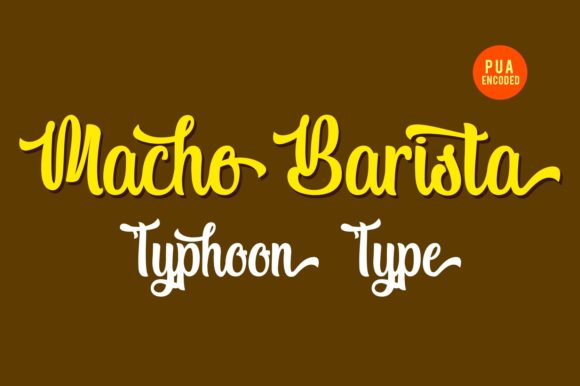
Two weeks ago, I was finalizing the hero section of a boutique online store’s new product landing page — think artisanal coffee gear, minimalist photography, and a voice that balances warmth with quiet confidence. The headline needed to feel human, intentional, and unmistakably hand-crafted. That’s when I dropped Macho Barista into Figma as a display option. Instantly, the layout shifted — not just visually, but emotionally. Macho Barista is a Script Handwritten font with confident strokes, subtle contrast, and rhythmic spacing — less “dainty script,” more “assured barista writing your name on a ceramic mug.” It’s not decorative for decoration’s sake; it carries presence.
Macho Barista for Logo Design and Hero Section Headlines
I tested Macho Barista as the primary logo treatment for the store’s wordmark — no icon, just typography. At 48px on desktop and 36px on mobile, it held clarity without thinning out or collapsing. Its open counters and generous x-height kept legibility intact even against soft image overlays. As a Script Handwritten font, it avoids the fragility some handwritten fonts show at smaller sizes, making it viable for responsive logo lockups. For hero headlines, I paired it with Inter (a neutral, highly legible sans serif) — Macho Barista for the emotional hook (“Brew With Intention”), Inter for the supporting subhead. That contrast created instant hierarchy: one font invites, the other informs.
Macho Barista for Product Packaging and Online Shop Banners
The client also uses Macho Barista across physical packaging mockups — think matte-finish boxes and reusable cotton bags. When translating those assets to digital, I reused the same font in banner graphics and product card accents. Because Macho Barista is built as a premium Fonts release, it includes OpenType features like contextual alternates and swashes — I toggled these selectively for hero banners where visual rhythm mattered more than strict consistency. On shop pages, I limited Macho Barista to product names only (not descriptions or pricing), preserving scannability while reinforcing brand tone. It worked especially well for limited-edition drops — that slight irregularity in stroke weight subtly signals “handmade,” not algorithmic.
Macho Barista for Social Media Greeting Cards and Campaign Landing Pages
Last month, the team launched a holiday campaign with custom social media greeting cards — animated PNGs shared across Instagram and email. Using Macho Barista for short phrases like “Warm Wishes” or “Cheers to You” gave them immediate warmth and personality. As a Script Handwritten font, it avoided the sterility of system fonts while staying legible at thumbnail size. I tested readability on dark mode feeds and light backgrounds alike: its medium contrast and balanced letterfit meant no awkward clipping or anti-aliasing blur. For the campaign’s micro-landing page, I used Macho Barista only in the headline and CTA button label (“Claim Your Blend”). Everything else stayed in a clean, variable sans serif — reinforcing that Macho Barista shines brightest when given breathing room.
Macho Barista for Clothing Labels and Branded Web Content
The client sells branded apparel — linen tees, aprons, embroidered tote bags. Their web product pages feature close-up lifestyle shots where text appears overlaid on fabric textures. Here, Macho Barista performed surprisingly well: its slightly bolder baseline and restrained flourishes resisted visual noise better than lighter script fonts. I used it sparingly — only for tagline-style phrases stitched into product imagery (“Made by Hand. Served with Care.”) — never for body copy or sizing charts. As a Script Handwritten font, it adds tactile authenticity without sacrificing polish. Just be sure your Fonts package includes web-optimized WOFF2 files and proper licensing for commercial use — I verified this before embedding via CSS @font-face.
Macho Barista for Name Tags and Digital Brand Kits
In a recent digital brand kit I built for a creative coaching practice, Macho Barista became the anchor for all “human-facing” elements: speaker name tags for virtual summits, downloadable workshop certificates, and email signature accents. Its friendly authority made credentials feel personal, not corporate. Because it’s a Script Handwritten font designed for versatility — not just calligraphy — it scaled cleanly from 24px (email footers) up to 96px (presentation title slides). I paired it with a warm, low-contrast serif (like Cormorant Garamond) for editorial sections and a crisp sans for forms and navigation. The result? A cohesive, layered typographic system where Macho Barista handled expression, and supporting fonts handled function.
Macho Barista for Advertising and Editorial Blog Headers
I recently added Macho Barista to a blog redesign for a small design studio. Instead of using it site-wide, I reserved it strictly for post headers and newsletter subject lines — moments where tone and memorability matter most. In digital advertising (Google Display, Meta carousel ads), I used Macho Barista for short, benefit-driven headlines — “Your First Design Sprint, Done.” — always over solid-color or softly blurred backgrounds. Its confident rhythm stopped scrolls without demanding attention. As a Script Handwritten font, it stands apart from the sea of geometric sans serifs dominating ad spaces — but only because it’s intentionally restrained, not overly ornate. No ligatures, no excessive swashes: just clarity with character.
Practical Tips Before You Use Macho Barista on Your Site
- Check file formats: Ensure your Fonts license includes WOFF2 for web use and OTF/TTF for design tools.
- Test responsiveness: Preview Macho Barista at 24px, 32px, and 48px across iOS Safari and Chrome Android — avoid using it below 20px.
- Pair wisely: Pair Macho Barista with a highly legible sans serif (e.g., Inter, Manrope, or a variable font) for body text — never another script.
- Avoid overuse: As a Script Handwritten font, Macho Barista works best for short, high-impact phrases — headlines, CTAs, logos, and accent text.
- Verify licensing: Confirm commercial rights cover client work, SaaS dashboards, e-commerce platforms, and digital templates.